


Jan Eufinger, University of Hagen
Introduction
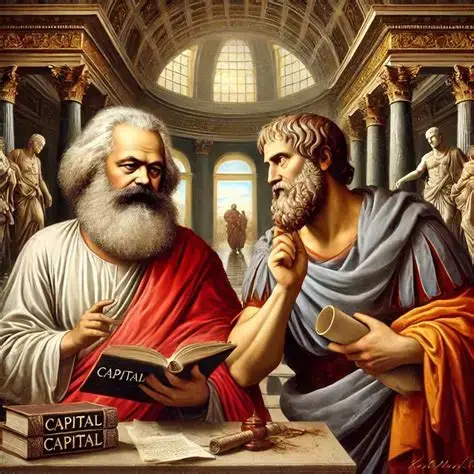
The idea of linking Marx and Aristotle may come as a surprise to anyone unfamiliar with the work of Alasdair MacIntyre. However, this synthesis is fruitful for both sides: the history of Marxism and the Left as a whole is a history of going astray – in the 20th century, the catastrophe of authoritarian state socialism; and in the 21st century, the abandonment of former core beliefs in favour of individualism. The Aristotelian tradition can provide a much-needed change of course here. Marx’s insights into the workings of capitalist societies, in turn, are central to bringing Aristotelian concepts up to date.
Globally, the Left presents itself as the moral antithesis to selfish and ‘right-wing’ ideas. Left-wing and Marxist movements claim to be striving to improve the world. Yet in the so-called ‘real-existing socialist’ states, they ended up as brutal regimes. Marx is not refuted by what others did in his name. Nevertheless, this gives rise to a need for every left-wing movement to reflect on how these crimes could have come about and how its own movement can prevent similar missteps. The philosopher Alasdair MacIntyre, who died in 2025 and had been exploring the moral foundations of Marxism since the 1950s, took on this task. For him, the absence of such a moral foundation is responsible for the crimes of the real-socialist regimes: the mere invocation of the interests of the working class (today: of the oppressed and disadvantaged) leads to a way of thinking in which the end justifies the means. This becomes particularly problematic when it is combined with a claim to be the vanguard or with the historico-philosophical thesis of inevitable progress.
The problem of moral pluralism
Occasionally, attempts are made to resolve this problem by combining Marxist criticism with one of the dominant moral philosophies, such as that of Immanuel Kant. For MacIntyre, however, this is not an option. He points out that none of the Enlightenment moral philosophies has been able to prevail over the competing approaches. They all have their supporters, and the arguments put forward by each side are generally insufficient to convince the supporters of the others. It is no coincidence that we are witnessing moral pluralism today – incompatible moral conceptions clash within society. But why is this pluralism a problem? When the adherents of these theories discuss social issues, a rational resolution of the conflict is impossible due to the aforementioned incompatibility. Elements of moral theories are increasingly being used out of context and arbitrarily to justify interests and lend them a moral veneer. Consequently, however, conflicts between these interests can no longer be resolved through moral reasoning. Nor does the political debate any longer have a generally recognised standard for resolving conflicts of interest. To prevent society from falling apart, the resolution of social conflicts is shifting ever more from public debate and the political process into the sphere of the law. This, however, amounts, on the one hand, to an erosion of democracy and, on the other, to mere superficial solutions. For the conflict has now shifted to the question of the formulation and, in particular, the interpretation of the law. In the USA, the appointment of the Supreme Court has long been a central arena of political contention. In Germany, too, the selection of members of the Federal Constitutional Court has recently become a political issue.
Virtue, Practice and the Good Life
As an alternative to the dissolution of morality into interests, MacIntyre presents a modernised version of Aristotle’s ethics. According to Aristotle, all human beings strive for eudaimonia. This is traditionally translated as ‘happiness’; alternative suggestions include ‘flourishing’ or ‘the good life’. Eudaimonia is not a final state that we need only attain once – it is the sum of its parts and must be realised anew time and again.
In our activities, we can pursue two kinds of goods. The first are ‘intrinsic goods’ or ‘goods of excellence’, where we engage in an activity for its own sake. The second are ‘external goods’ or ‘goods of efficiency’, where the activity is merely a means to achieve other ends. An activity that we also carry out for its own sake within a social context is called a practice. Take football as an example: club culture and the beauty of the game are intrinsic goods, whilst the players’ salaries and the profit generated by the club are extrinsic goods. This distinction runs through most areas of our society. In the education system, for instance, the intrinsic good of personal development is weighed against the extrinsic good of preparing for the labour market. MacIntyre points out that the goods of excellence usually compete with the goods of efficiency and are threatened by them. According to Aristotle, whilst we do need a certain degree of external, i.e. material, goods in order to lead a good life, it is exclusively the goods of excellence that lead to eudaimonia. Capitalism, with its structurally embedded pursuit of profit—which is enforced by market-driven competition—pursues purely material goods and thus goods of effectiveness. Wage labour, too, is generally undertaken for the sake of external goods (wages), resulting in a form of alienation of people from their work, as it essentially no longer constitutes a practice.
Qualities that help us to engage in genuine practice and to carry out activities for their own sake are called arete, which is classically translated as ‘virtue’ or ‘excellence’. Virtues are another central component of eudaimonia. For Aristotle, they represent a middle ground between two extremes. Courage, for instance, is the right balance between cowardice and recklessness. However, where this right balance lies varies depending on the situation and the individual. To determine the right balance, we therefore need phronesis, or practical wisdom. Virtues cannot, therefore, be taught in the same way as knowledge or mathematics, but must be learned through practice. They cannot be acquired through books, nor can they be acquired alone, that is, individually. According to Aristotle, we need role models and teachers who show us, through concrete practice, what virtuous behaviour is. It is by imitating them and practising virtuous actions that we become virtuous. For this reason alone, the goods of excellence can only be attained within the context of social practice. As the example of football shows, many of these are also, by their very nature, communal goods that can only be attained through cooperation. The flip side: conversely, it is also true that those who behave viciously reinforce this behaviour through their actions.
The realisation of human potential
But what, then, does eudaimonia consist of? Here, we must first consider Aristotle’s teleological biology: for Aristotle, all living beings have a purpose of their own, a goal towards which they strive. Human beings are social beings (zoon politikon) as well as rational beings (zoon logikon). We humans therefore strive to develop our reason and to live within a community. The aim is the realisation of human potential. Aristotle therefore rejects hedonistic conceptions of eudaimonia, for whilst the satisfaction of physical needs is, for him, a necessity, the mere pursuit of physical pleasure is an animal mode of existence. Eudaimonia, as the sum of its parts, requires rather the satisfaction of material needs, well-ordered political conditions and the opportunity to practise ‘theoria’ – that is, to engage in reason.
However, Aristotle’s biology is now regarded as having been refuted by modern science. It seems that the world is not organised teleologically. We no longer understand the world through an inner striving of things, but through cause and effect. MacIntyre therefore rethinks the connection between human nature and reason. He compares humans with other intelligent animals and thus demonstrates that reason is something that belongs to us as natural beings. Nature and reason are therefore not two opposing aspects of human existence. In this regard, he takes the view that there is no fundamental naturalistic fallacy; rather, only certain types of inferences from nature to ethics are flawed. Being social beings and developing our reason are goals that our nature imparts to us.
The contradiction between virtue and capitalism
Any significant practice requires a certain institutionalised framework in order to sustain itself over the long term. Institutions, however, are bureaucratic structures geared solely towards external goods. Whilst they are therefore a prerequisite for sustainable practice, they simultaneously carry the risk that external goods will displace the goods of perfection. The principle of capitalism is the generation of profit – that is, the acquisition of external goods – and it tends to subject all areas of life to this logic. Aristotelianism, on the other hand, emphasises the primacy of the goods of excellence for the sake of eudaimonia. Herein lies its revolutionary character: institutions that orient a practice towards external goods and supplant the goods of perfection must be abolished and replaced with better ones. This applies all the more to an economic system that recognises only external goods.
In his last book, ‘Ethics in the Conflicts of Modernity’, MacIntyre makes it clear: capitalism, the market economy and the modern state are based on exploitation and stand in opposition to the virtues and the goods of excellence. “We therefore have to live against the cultural grain, just as we have to learn to act as economic, political, and moral antagonists of the dominant order.” (MacIntyre 2016, p. 238.) It is therefore a matter of establishing, in conflict with the capitalist social order, practices and institutions oriented towards excellence and the attainment of communal goods. It is only through this resistant practice that a ‘revolutionary transformation’ becomes conceivable at all. It is this that provides the basis for a liberated society; for MacIntyre, attempting to develop such a society purely from an abstract critique of the existing order either fails fundamentally or leads to a reiteration of Stalinist crimes.
Social criticism must therefore not appeal to particular interests and merely seek the most effective means to serve those interests. Nor are institutions such as the state neutral means that can simply be repurposed for a different end. Aristotelianism itself, with its concept of virtuous practice, points beyond capitalism. Whilst Marx’s critique of political economy provides an analysis of the structures of capitalism, MacIntyre’s neo-Aristotelianism offers us the vision of a better life through a different practice and thus the path towards a new society. Both Marx and MacIntyre are concerned with ensuring that people can freely develop their potential and have the opportunity to live a good life. The world one ends up with is shaped by the practices one builds this world with. Anyone who, in political practice today, relies on the oppression of other opinions, on ‘cancel culture’ or on violence will also build a society that functions according to these principles. The Aristotelian conception of virtue and practice thus represents, not only in theory but also in practice, a safeguard against aberrations of Marxism and the Left as a whole.
Add comment
Comments